
Leaking Gutters Diagnosed and Fixed Accurately
Gutter Repair in Springfield for sagging sections, leaking joints, failed hangers, and water that no longer routes toward downspouts correctly
A gutter that drips at the seam during rain or sags noticeably between hangers isn't always a system that needs full replacement—and being told otherwise costs homeowners money they don't need to spend. Townsend Seamless Gutter Company has diagnosed gutter systems in Springfield and Rogersville for 42 years, which means the difference between a fixable hanger failure and a system that's genuinely at the end of its service life is a distinction made from experience, not from a pricing sheet. Honest diagnosis drives the recommendation, not the cost of the service option.
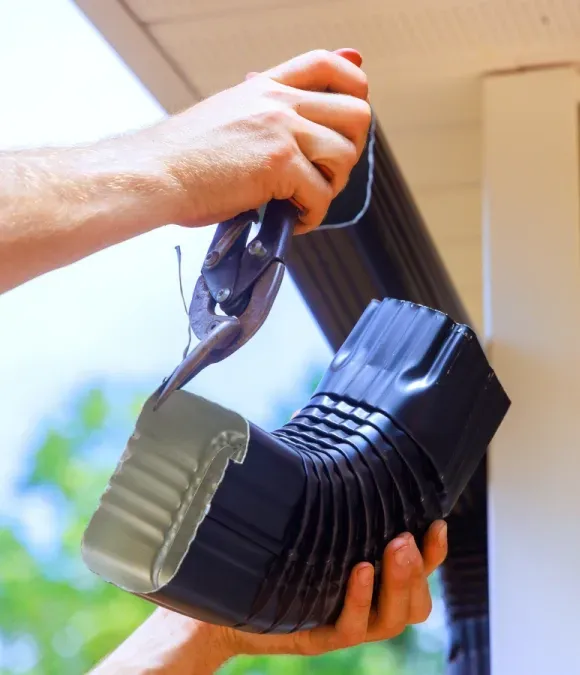
A full gutter repair inspection examines every component of the system rather than stopping at the visible failure point. Leaking joints, sagging sections, improper pitch that holds standing water, weak or missing hangers, and damaged end caps all affect whether water reaches the downspout—and a repair that addresses only the symptom the homeowner noticed leaves the underlying cause in place. The repair process may include resecuring loose gutter sections, correcting pitch along affected runs, replacing failed hangers, sealing active leaks, and adjusting water flow paths toward functioning downspout outlets.
Arrange a gutter inspection to identify what's actually causing the drainage problem before committing to a repair or replacement decision.
Why Gutter Problems Happen and How to Stop Them
Most gutter failures in the Springfield area follow predictable patterns. Hangers installed with standard spikes pull loose from the fascia as the wood behind them compresses through freeze-thaw cycling, which allows the gutter channel to drop and reverse pitch in isolated sections. Reversed pitch means water pools rather than flows, and pooled water accelerates corrosion at the seam locations nearest the low point. That sequence—loose hanger, reversed pitch, pooling, seam failure—can progress over two to three seasons before the homeowner sees anything more obvious than a drip line in the mulch below.
After repairs are completed, the corrected sections hold proper slope, water moves through the full channel toward downspouts without pooling, and the dripping or overflowing that marked the problem location stops. Sagging that was visible from the ground will be visually level again along the repaired run. Any mistake in the repair work is corrected immediately at no charge—the same standard applied across every job Townsend Seamless Gutter Company handles.
The line between repair and replacement depends on how much of the system is structurally sound. When damage is isolated—one sagging section, two failed hangers, a single leaking joint—targeted repair is the right answer. When pitch problems run the full length of a gutter run, the fascia board behind the mounting points shows rot, or the channel metal has corroded through at multiple locations, replacement becomes the more cost-effective path. That evaluation is made honestly, with the specific condition of your system driving the recommendation.

Answers to Frequent Gutter Repair Questions
Springfield and Rogersville homeowners ask these questions most often when trying to decide whether to repair or replace a failing gutter system.
How do I know whether my gutters need repair or full replacement?
The condition of the fascia board behind the mounting points is often the deciding factor—when moisture has reached the wood and caused rot along the attachment zone, repair alone won't solve the underlying drainage problem because the mounting surface itself has failed.
What causes gutters to sag between hangers?
Hanger spacing that was too wide at installation, combined with the weight of seasonal debris accumulation, allows the channel to flex downward—once the pitch reverses at the low point, water no longer moves toward the downspout and pooling accelerates the sagging further.
When should I repair my gutters instead of waiting until spring?
Active leaks against fascia boards during fall and winter allow moisture to work behind the wood before temperatures drop low enough to slow the damage—addressing leaks and failed hangers before winter sets in prevents the kind of moisture damage that turns a repair into a fascia replacement job.
Why does water still drip at the corner joints after I re-caulked them?
Corner miters that leak repeatedly after sealing usually indicate that the joint has shifted out of alignment—caulk bridges a gap but doesn't correct the underlying movement, which means the seal fails again within a season or two without realigning and resecuring the joint.
How much of a gutter system can typically be repaired without full replacement in this region?
In most cases where the system was originally installed correctly and the fascia is structurally intact, isolated failures—sagging spans, individual hanger failures, single seam leaks—are fully repairable without replacing the entire run.
Townsend Seamless Gutter Company provides straightforward repair assessments across Springfield and Rogersville—call (417) 299-1607 to schedule an inspection and get a clear picture of what your system actually needs.